


 Campus Walk
- CONSULTANCY SERVICES OFFERED BY DEPARTMENT OF PHYSICS
UV-Visible-NIR Spectrometer
Faculty-In charge: Dr. P. Matheswaran, Assistant Professor, Department of Physics
Ph : 84896 22002 email: mathesphy@kongunaducollege.ac.inDownload : User request form for UV-Vis-NIR
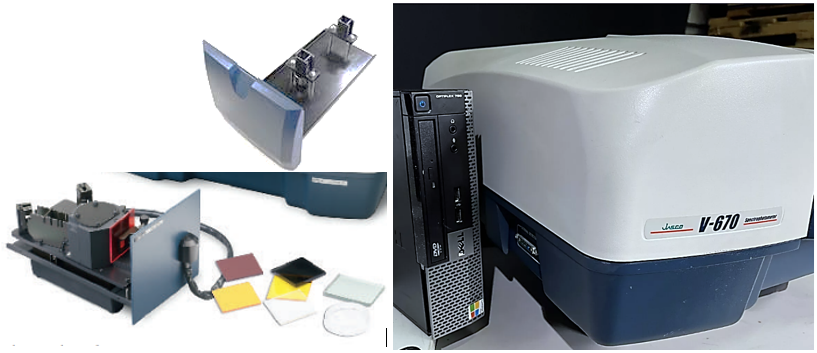
JASCO V670 Spectrophotometer with Integrating hemisphere
JASCO V670 UV-Vis-NIR spectrophotometer is a high-performance instrument used for measuring absorbance and transmittance across the ultraviolet, visible, and near-infrared regions.
Technical Specifications:
• Wavelength Range: 200-2500 nm
• Monochromator Design: Single monochromator with dual gratings offering high throughput and low stray light.
• Detectors: Photomultiplier tube (PMT) for UV/Vis and Peltier-cooled PbS detector for NIR.
• Spectral Bandwidth: Variable from 0.1 nm (UV/Vis) to 0.4 nm (NIR).
• Scanning Speed: 10-4000 nm/min (UV/Vis) and 48,000 nm/min (NIR).
• Accessories: Supports integrating spheres for DRS, Liquid and Thin film holdersConsultancy Charge Details
Analysis Type Nature of Sample Internal (₹) External (₹) Industry (₹)
UV-Vis-NIR Glass, Thin film, Liquid 150 200 250
DRS Mode Powder 200 250 300Photoluminance Spectrophotometer (PL)
Faculty-In charge: Dr. S. Selvi, Assistant Professor, Department of Physics
Ph : 94439 19100 email: selvis_ph@kongunaducollege.ac.inDownload : User request form for PL
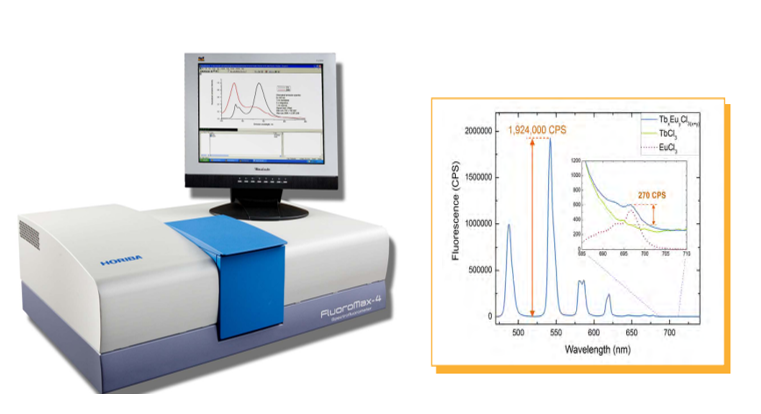
HORIBA FluoroMax-4 Spectrofluorometer
The HORIBA FluoroMax-4 Spectrofluorometer typically operates across a spectral range of 200 nm to 950 nm for both excitation and emission, often utilized for UV-visible fluorescence measurements. The system features a 150 W Xenon lamp, with standard detectors optimized for the visible region (up to 850 nm).
Technical Specifications:
* Excitation/Emission Range: 200–950 nm.
* Emission Detector Range: Standard R928P PMT operates from 200–850 nm.
* Monochromator Range: Excitation (220–600 nm, blazed at 330 nm) & Emission (290–850 nm, blazed at 500 nm).
* Spectral Bandpass: Continuously adjustable from 0–30 nm.
* Wavelength Accuracy: ±0.5 nm.
Consultancy Charge Details
Analysis Type Nature of Sample Internal (₹) External (₹) Industry (₹)
PL Spectra Glass, Thin film, Powder 200 400 750
- CONSULTANCY SERVICES OFFERED BY DEPARTMENT OF CHEMISTRY
Fourier Transform Infrared Spectroscopy (FTIR) - Under maintenance
Atomic Absorption Spectroscopy (AAS) - Under maintenance
- CONSULTANCY SERVICES OFFERED BY DEPARTMENT OF BOTANY
STEAM DISTILLATION EXTRACTION UNIT WITH LOW TEMPERATURE CIRCULATOR
Faculty-In charge:
Dr. K. Sowndhararajan, Assistant Professor, Department of Botany,
Contact No.: +91 73392 18798
Email: sowndhark_bo@kongunaducollege.ac.in
A steam distillation extraction unit paired with a low-temperature circulator (chiller) is an advanced setup used to isolate pure essential oils and heat-sensitive aromatic compounds.
The low-temperature circulator pumps chilled fluid through the condenser coils, ensuring rapid and complete condensation of volatile vapours without thermal degradation

TECHNICAL SPECIFICATIONS:
Equipment: Steam Distillation Extraction Unit with Low-Temperature Circulator
Extraction principle: Steam distillation
Application: Extraction of essential oils and volatile phytochemicals from plant materials
Extraction vessel: Heat-resistant laboratory-grade vessel suitable for plant material
Steam generation: Integrated steam generation/heating system
Condenser: Water-cooled condenser for condensation of volatile vapours
Circulation system: Low-temperature circulating system for controlled condenser cooling
Temperature control: Adjustable temperature control for extraction and cooling
Material of construction: High-quality laboratory-grade glass/stainless-steel components, depending on the unit configuration
Oil collection: Receiver/separating arrangement for collection of essential oil and hydrosol
Operation: Batch-type steam distillation
Typical applications: Essential oil extraction, phytochemical research, aromatic plant analysis, and plant biotechnology research.
Consultancy Charge Details
Nature of Sample: Fresh Plant Leaf/Stem/Root Samples
Internal (₹) = 400 /-
External (₹) = 500 /-
Industry (₹) = 700 /-
PLANT IDENTIFICATION AND AUTHENTICATION CERTIFICATE
Faculty-In charge:
Dr. V. Aravindhan, Assistant Professor, Department of Botany,
Contact No.: +91 97897 83504
Email: varavindhan_bo@kongunaducollege.ac.in
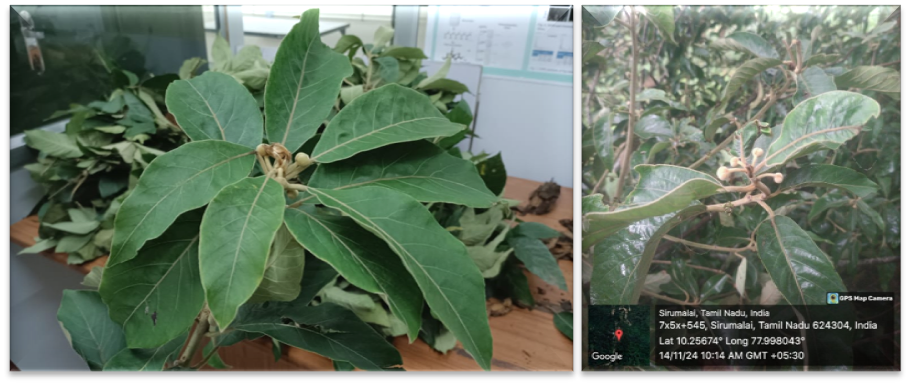
Importance for Plant Identification and Authentication
A Plant Identification and Authentication Certificate is important to scientifically confirm the correct identity and taxonomic authenticity of the plant material used in research.
The certificate should be issued by a qualified faculty member/plant taxonomist with expertise in plant taxonomy and identification.
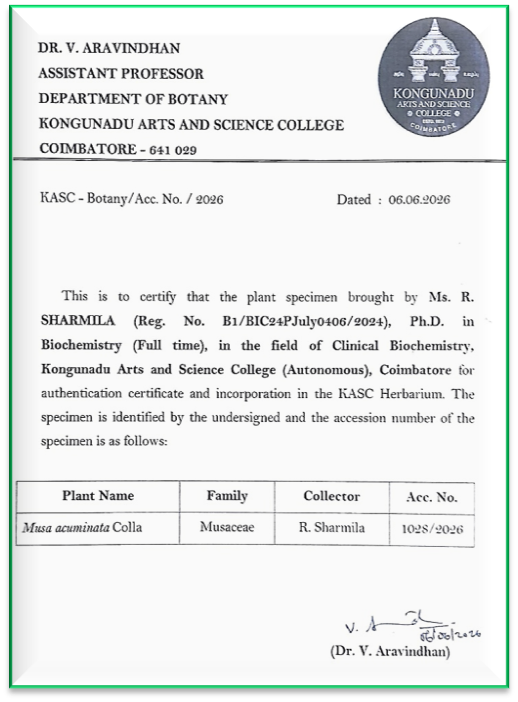
It provides documented evidence of the plant's accepted scientific name, family, voucher specimen/herbarium reference, and authentication details, thereby ensuring the reproducibility, reliability, and scientific validity of the research findings.
It is particularly important for studies involving medicinal plants, phytochemical analysis, essential-oil extraction, pharmacological studies, and plant biotechnology.
Consultancy Charge Details
Nature of Sample: Plant image with Flowers and Fruits, Fresh Plants and Dried Specimens
Internal (₹) = 150 /-
External (₹) = 200 /-
Model Certificate
- COMMON INSTRUMENTATION LAB
LIST OF INSTRUMENTS
Electronic Analytical Balance
Hot Air Oven (Scientex)
Binocular Microscope
Micro Pipette (100 µL - 1000 µL)
Micro Pipette (20 µl -200µl)
Water Bath Rectangular
Magnetic Stirrer
Bench Top Orbital Shaker
Microprocessor-Based PH Meter
Haematology Analyzer
B.O.D Incubator (Scientek)
Incubator (Scientek)
Western blot Apparatus (Chromos Biotech)
UV Visible Spectrophotometer (Cyberlab)
UV Visible Spectrophotometer (JASCO V - 730)
Ultra Low Temperature Freezer (ULF 390)(-86⁰ C)
Refrigerated Centrifuge (REMI C – 30 Plus)
Refrigerated Centrifuge (REMI CPR – 30 Plus)
High-Speed Refrigerated Microcentrifuge