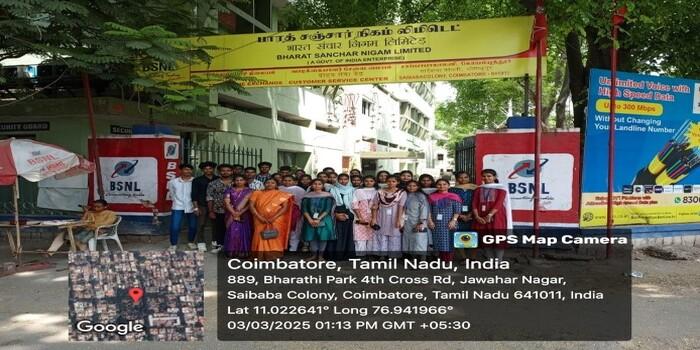

 Campus Walk
The BSNL personnel, Mobile switching centre discussed about GSM. GSM stands for Global System for Mobile Communication. GSM is an open and digital cellular technology used for mobile communication. It uses 4 different frequency bands of 850 MHz, 900 MHz, 1800 MHz and 1900 MHz . It uses the combination of FDMA and TDMA.
It has a number of outgoing lines to one or more nearby switching centers, called toll offices (or if they are within the same local area, tandem offices). These lines are called toll connecting trunks. If both the caller's and caller's end offices happen to have a toll connecting trunk to the same toll office (a likely occurrence if they are relatively close by), the connection may be established within the toll office. A telephone network consists only of telephones (the small dots), end offices (the large dots), and toll offices
If the caller and caller do not have a toll office in common, the path will have to be established somewhere higher up in the hierarchy. Primary, sectional, and regional offices form a network by which the toll offices are connected. The toll, primary, sectional, and regional exchanges communicate with each other via high-bandwidth intertoll trunks (also called interoffice trunks). The number of different kinds of switching centers and their topology (e.g., can two sectional offices have a direct connection or must they go through a regional office?) varies from country to country depending on the country's telephone density.
The BSNL Personnel has briefly explained about the ISO/OSI layers and demonstrated how seven layers will transform the information through signals. He explained about the fiber optic cables and co-axial cables. Fiber optics cables transmit the light waves very fastly and distortion is very less. In co-axial cable distortion is high. Further he imparted knowledge about mobile switching which includes the following concepts.
Cellular telephones comes under unguided media that is wireless medium. It has 2 types of frequencies. Sender has one type of frequency and receiver has another type of frequency. In mobile phone system the area covered is divided into small regions known as cells. It is called as cellular phones. The cells are circular but they are hexagonal in shape. Each cell has an antenna and cell office to control the cell. A Mobile Telephone Switching Office [MTSO] controls various cell offices and co ordinates the communications between them. In telephone system, the Telephone Control Office [TCO] or Telephone Exchange [TE] controls all the system. It is a wired telephone system. MTSO is responsible not only for the connections but also to transmit information and billing for calls. Typical cell radius size is 0-12 Milles. It can be changed depending on the population of the area Analog transmission is used for cellular telephones. Frequency modulation is used for communication between mobile phone and cell office.